
May 15, 2026
Par Levels for Restaurant Inventory: A Practical System for Cash, Waste, and Service
A practical guide to par levels for restaurant inventory to improve cash flow, cut waste, and maintain reliable service across purchasing and prep.
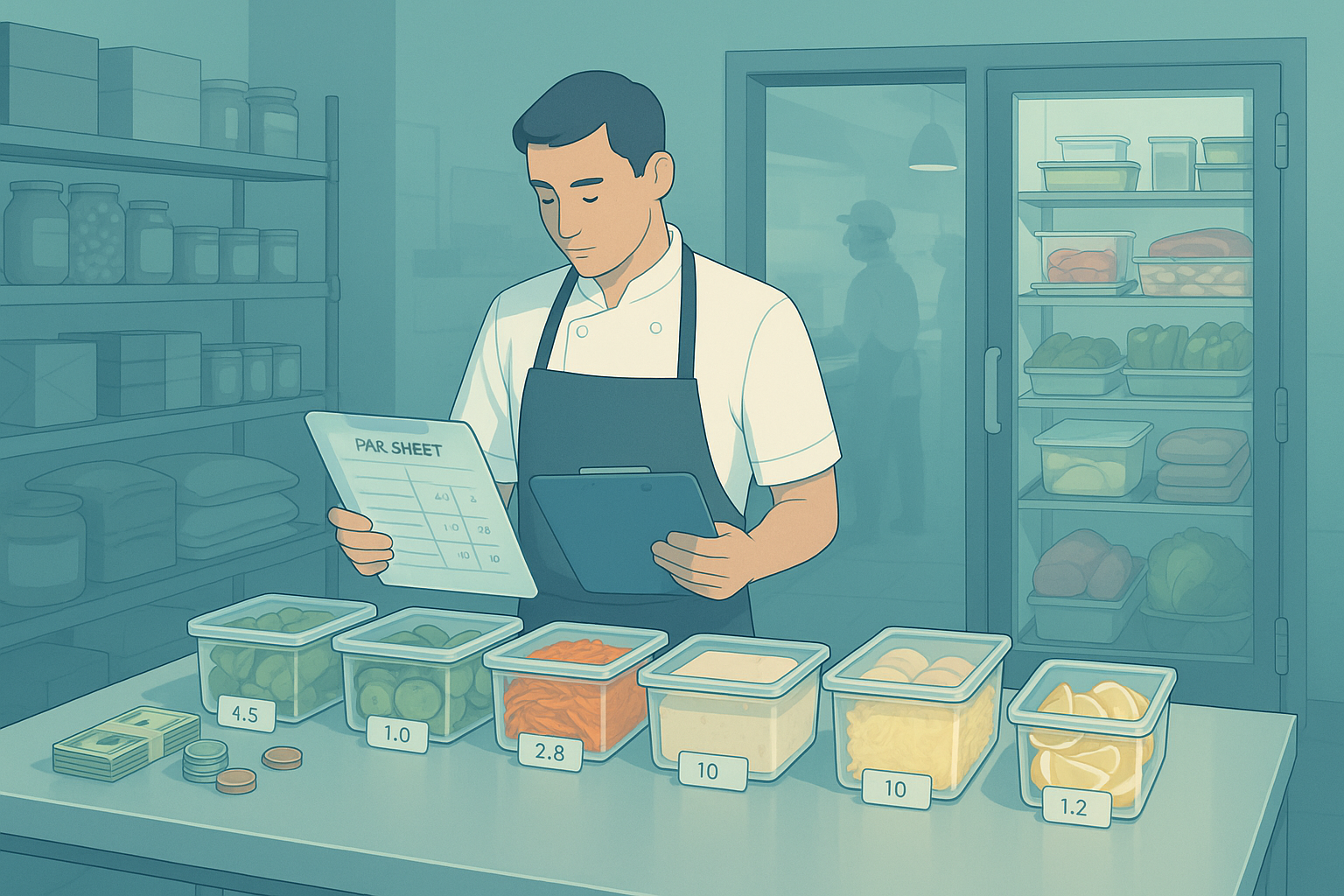
Prime cost can move 2–4 points from inventory drift alone. A unit doing $2 million in annual sales feels that in cash, waste, and missed orders. Par levels for restaurant inventory give operators a usable control system for deciding how much of each item to keep across storage, prep, and purchasing.
What par levels actually mean in a restaurant
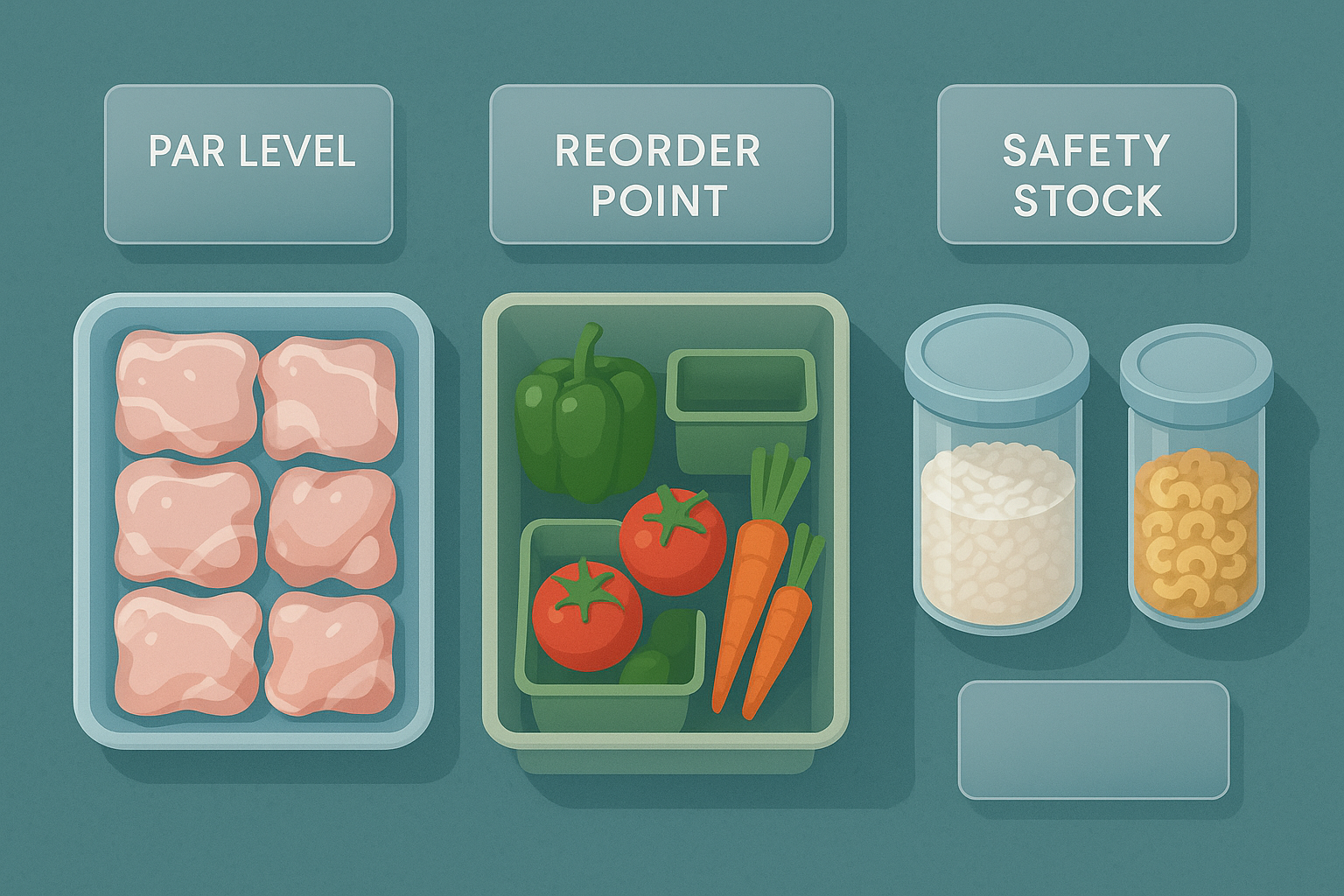 Par level, reorder point, and safety stock are related, but each serves a different operating decision.
A par level is the target quantity of an item you want available to run the business through a defined period. In restaurant terms, that period is usually the time between deliveries, inventory counts, or prep cycles. The goal is straightforward: enough stock to support expected demand plus a measured buffer for normal variability.
That definition matters because operators often mix up three different concepts:
- Par level: target quantity to have on hand
- Reorder point: quantity that triggers a purchase
- Safety stock: extra buffer held above expected usage
Those terms overlap, but they are not interchangeable.
A kitchen might hold a par of 36 pounds of chicken thighs for a two-day cycle. The reorder point could be 18 pounds if the supplier lead time is one day. Safety stock might be 6 pounds to cover a Friday night sales spike or a short delivery. Each number serves a different purpose.
The par level meaning in restaurant operations also changes by item type:
Ingredients
Raw proteins, produce, dairy, dry goods, oils, and spices usually need pars tied to usage rate, shelf life, and delivery cadence. Fresh herbs and avocados need tighter controls than rice or flour.
Packaging
Lids, bowls, cups, bags, napkins, and labels rarely spoil, but they still tie up cash and storage space. Packaging stockouts also stop revenue just as effectively as ingredient stockouts in a delivery-heavy or QSR model.
Prep items
Portioned sauces, sliced vegetables, cooked grains, batched dressings, and marinated proteins need pars at the prep station level. These are often the least formalized and the most expensive to mismanage because waste happens after labor has already been invested.
For most operators, restaurant inventory par levels work best when they are treated as operating standards rather than static spreadsheet values. They should tell the opener, the kitchen manager, and the purchaser the same thing: this is the quantity we aim to have at this station, in this cooler, for this service window.
How par levels affect cash, waste, and service reliability
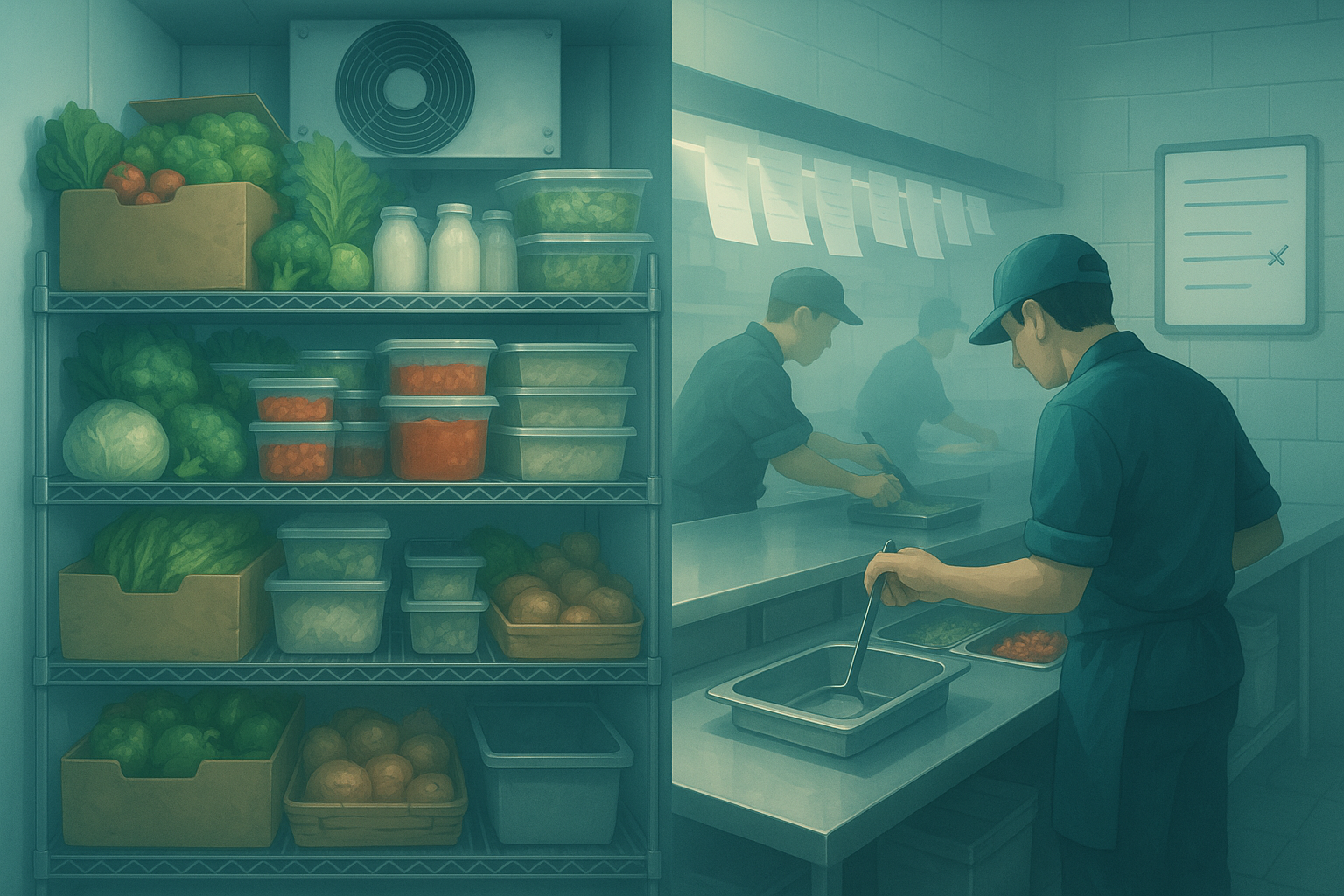 Set pars too high and you buy waste; set them too low and service breaks when demand hits.
Par levels are a balancing mechanism. Set them too high and the business carries excess inventory. Set them too low and the floor pays for it in stockouts, substitutions, and inconsistent execution.
Here is the cash side first.
If a five-unit fast-casual group carries $8,000 of avoidable excess inventory per store, that is $40,000 tied up with no return. Add 2% weekly spoilage on perishable overstock and the annual drag becomes material. On a single unit level, even $1,500 of unnecessary inventory can equal a month of utilities or a meaningful share of marketing spend.
Waste is the second effect.
High pars increase the odds that perishable items expire, degrade, or get over-prepped to justify holding levels. A prep cook who sees six cambros of cut romaine in the walk-in often keeps producing to the visual standard rather than to actual need. That habit turns an inventory mistake into a labor and food-cost problem.
Service reliability is the third effect.
Low pars create a different set of costs:
- 86s during peak periods
- forced substitutions
- menu item outages on third-party channels
- larger comp checks when expectations are missed
- slower ticket times when staff improvise around missing product
A stockout on a top-5 PMIX item can erase a full day of margin improvement from tighter labor scheduling. If the unavailable item is attached to modifiers or combo sales, the loss is wider than the base item itself.
This is why reduce food waste with par levels is only half the story. Good pars also protect revenue. The right number is not the lowest possible stock position. It is the quantity that supports expected service with acceptable risk and acceptable cash exposure.
The variables that should shape each item’s par level
Most bad pars come from oversimplification. A manager takes last month’s count, adds a cushion, and leaves the number untouched for 90 days. That approach misses the operational inputs that actually drive inventory demand.
Here are the variables that matter most.
1. Sales velocity
Start with average daily usage tied to actual sales mix, not intuition. If the store sells 140 chicken bowls per day and each bowl uses 5.5 ounces of cooked chicken, the baseline demand is visible. Add catering, online bundles, and modifier usage where applicable.
Velocity should be measured by SKU or recipe ingredient, not broad category. “Chicken” is too vague if one cut serves bowls, salads, wraps, and limited-time offers with different yields.
2. Delivery cadence and lead time
An item delivered six days a week needs a different par than one delivered twice weekly. Lead time matters too. If produce orders placed by 3 p.m. arrive next morning, the buffer can be tighter than for frozen goods on a three-day cycle.
A practical par level formula starts here:
Par level = expected usage during order cycle + safety stock
For a more operational version:
Par level = (average daily usage × days until next replenishment) + buffer
That is the simplest answer to how to calculate inventory par levels. Most restaurants stop there. Better operators add item-specific adjustments.
3. Shelf life
Shelf life should compress or expand the buffer. Fresh fish, cut tomatoes, and house-made aioli cannot carry the same cushion as canned tomatoes or paper goods.
If an item’s usable life is shorter than the replenishment cycle plus safety stock, the par is wrong by definition. That product should have a lower par, a more frequent order schedule, or a different prep cadence.
4. Prep yield and trim loss
Raw quantity is not usable quantity. Ten pounds received does not mean ten pounds available for sale. Proteins shrink in cooking. Produce loses weight in trimming. Citrus gets juiced. Greens get cleaned and culled.
Yield needs to sit inside the calculation. If cooked yield on a protein is 80%, a target of 20 usable pounds requires 25 pounds raw. Ignoring yield is one of the fastest ways to understate true pars.
5. Daypart demand
Breakfast-heavy, lunch-heavy, and dinner-heavy concepts need different buffers by shift. A store that does 55% of sales between 11:30 a.m. and 1:30 p.m. cannot use the same station pars as a dinner-led full-service unit.
Prep pars often work better by daypart than by day. For example:
- salsa for lunch line
- chicken tenders for after-school rush
- buns and fries for late-night volume
6. Promotions, weather, and local events
Promotional lifts should not be handled with guesswork. If a limited-time sandwich drove a 22% increase in brioche bun usage during the last campaign, that item needs a temporary par increase before the next launch.
Weather and local events matter at the store level. A downtown unit near a stadium has different variance than a suburban strip-center location. One static groupwide number usually misses that.
7. Location-specific variability
Multi-unit operators often standardize too early. One store may have tighter receiving space, less reliable vendor fill rates, or stronger weekend sales swings. Another may have a catering business that distorts weekday usage.
Restaurant inventory par levels should be consistent in method, not identical in output.
A practical framework for setting and reviewing par levels
A usable par system needs structure. Most restaurants do well with a category-based model tied to count cadence, item volatility, and decision ownership.
Set pars by category first
Group items into operational buckets:
- High-volume perishables: proteins, produce, dairy
- Prepared components: sauces, cut vegetables, cooked grains
- Shelf-stable ingredients: dry goods, canned goods, spices
- Packaging and disposables
- Critical low-usage items: allergens, specialty modifiers, limited menu items
Each bucket should have a default review cadence and a default buffer rule.
For example:
| Category | Base method | Review cadence | Typical buffer logic |
|---|---|---|---|
| High-volume perishables | Daily usage × delivery cycle | Weekly | 10–20% based on variance |
| Prepared components | Forecasted sales × recipe need | Daily or per shift | Tight buffer due to shelf life |
| Shelf-stable ingredients | Weekly usage × order cycle | Monthly | Higher buffer acceptable |
| Packaging | Average weekly usage | Monthly | Buffer based on lead time and storage |
| Critical low-usage items | Case-pack and outage risk | Monthly | Higher buffer due to service risk |
This creates consistency without flattening every SKU into the same rule.
Use a simple four-step calculation
A practical workflow looks like this:
- Calculate average daily or per-shift usage from recent sales and recipe data.
- Multiply by the number of days or shifts until replenishment.
- Adjust for yield, known variability, and shelf life.
- Add a measured safety buffer.
A worked example:
- Average daily avocado usage: 48 units
- Deliveries: every 2 days
- Expected demand over cycle: 96 units
- Weekend variance buffer: 12 units
- Shelf-life constraint: acceptable
- Par level: 108 avocados
That number should then be tested against actual depletion and waste over the next two to four cycles.
Validate against reality, not theory
Initial pars are estimates. Validation is where the control system gets useful.
Review these signals after implementation:
- stockouts and 86 frequency
- waste logs by SKU
- variance between theoretical and actual usage
- emergency purchases
- void rate or comp checks tied to unavailable items
- end-of-shift prep carryover
If avocados hit zero twice in one week, the par is too low or the ordering cadence is wrong. If 15 units are discarded every Monday, the par is too high for that part of the week.
Adjust on a schedule
Pars need maintenance. Good review triggers include:
- Weekly for high-volume perishables and prep items
- Monthly for shelf-stable goods and packaging
- Seasonally for patio traffic, school calendars, holidays, or tourism shifts
- Immediately after menu changes, vendor changes, case-pack changes, or price shocks
This is the operational answer to how to calculate inventory par levels over time: calculate once, validate quickly, then revise on a disciplined cadence.
Where restaurants go wrong with par levels
Most failures come from process design, not math.
One static number for the whole year
Traffic patterns change. Vendor reliability changes. Menu mix changes. A single par that survives spring break, patio season, and holiday catering is usually wrong in at least two of those periods.
Treating all SKUs the same
A case of paper cups and a pan of cut fruit should not share the same buffer logic. Shelf life, outage cost, and replenishment speed are different.
Ignoring production data
Some kitchens track purchases but not prep output. That leaves batched items disconnected from actual depletion. A prep par built without production counts usually creates either over-prep or mid-shift shortages.
Building pars from purchases instead of usage
Purchase history can hide poor ordering habits. If a store repeatedly overorders cheese and then uses it eventually, historical purchases will inflate future pars. Usage is the cleaner signal.
Failing to connect inventory to PMIX
Top sellers deserve tighter monitoring. If 38% of entrée sales run through three core items, the ingredients behind those items need more precise par management than slow movers.
Leaving pars in one manager’s head
Pars need to be visible at the shelf, station, or ordering screen. If only the GM knows the target, every day off creates variance.
How Bagel helps operators keep par levels usable
Par levels fail when data lives in separate systems. Sales are in one place. counts are in another. prep notes are on paper. vendor changes sit in email. By the time someone notices a pattern, the week is already closed.
Bagel helps keep par levels for restaurant inventory practical because sales, inventory, and operations data sit in one system. That changes the quality of the decision in a few concrete ways.
First, actual item movement can be tied back to PMIX and modifiers. Operators can see which ingredients are moving faster because guest demand changed, not because a purchaser guessed wrong.
Second, prep and storage pars can be managed as operating standards across shifts or locations. A kitchen manager can work from the same targets the purchaser uses, which reduces the gap between what is ordered and what is actually produced.
Third, exceptions are easier to spot. If one location is repeatedly short on lids, over on chicken, or carrying too much prepped sauce into close, the variance shows up quickly. That is how pars stay current instead of becoming stale documentation.
For multi-unit teams, the benefit is consistency in method with flexibility by store. Corporate can define the framework. Each location can maintain its own numbers based on cadence, sales pattern, and storage limits.
Conclusion
Par levels are one of the simplest control systems in restaurant operations. They influence cash on hand, waste rates, 86s, and purchasing discipline every week. The value comes from using them as live operating targets tied to actual sales, prep, yield, and delivery rhythm.
For operators tightening food cost without adding more admin, this is a good place to start. Bagel is building early access for teams that want inventory, sales, and daily ops working from the same source of truth.
Run your restaurant on Bagel
Join the early access program and shape the operating system built for modern hospitality.
Get early access →